






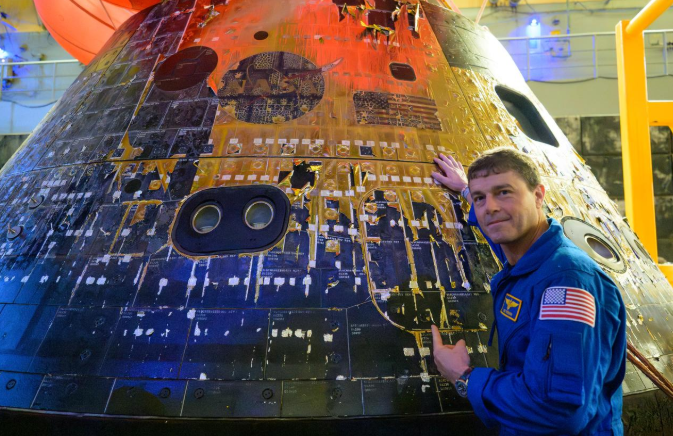








The United States made history, yet again, by breaking the record for the farthest manned flight in space. This is how they did it.
Artemis II launched on Wednesday, April 1, 2026. Their objective: take pictures of the dark side of the moon, and test for future Artemis missions. The trip was 10 days long. The astronauts – Commander Reid Wiseman, Pilot Victor Glover, Mission Specialist Christina Koch, and Mission Specialist Jeremy Hansen of the Canadian Space Agency – now hold the record for farthest manned flight from earth. Victor Glover is the first Black man to travel around the moon, and Christina Koch is the first woman to travel around the moon. They returned on April 11, 2026, landing in the Pacific just outside of San Diego.
The Science Behind This Major Operation
Artemis II used a “slingshot” technique, the free return trajectory, to save fuel and also serve as a fail-safe if the engines malfunction. The flight path consisted of two laps around Earth to test systems for future Artemis missions. After reaching the moon, Artemis II used the lunar gravity to set a free return trajectory back towards earth.
The engines of the craft, used to reach L.E.O (Low-Earth-Orbit), were two of NASA’s updated Space Launch System (SLS) and four RS-25 Space Shuttle Rockets. The SLS rockets are a solid fuel rocket meaning that the oxidizer (Liquid Oxygen) and fuel (Liquid Hydrogen) are already mixed. This type of rocket is much simpler than the liquid rocket type, where the fuel and oxidizer are stored in separate tanks. In a solid rocket, however, once the mixture is ignited it will burn continuously until the tank is empty. Moreover, the RS-25 rockets are a liquid rocket, which means they can be turned off.
Here’s how rockets work in space: they use the physics law of conservation of momentum, which states that the total momentum of a system remains constant. This means that thrust is produced from the rocket’s exhaust gases, meaning if the momentum is going one way the net momentum would be uneven. This would not abide by the law so the rocket must move forward to keep the net momentum equal. In simpler terms, imagine a balloon full of air, then let it go. It would fly around the room as the air escaped out of the balloon’s nozzle. That’s how a rocket works. That same balloon would still move in space, by the same principles.
NASA’s Artemis program has a vision of establishing a lunar colony to conduct further research on the moon. A NASA published article stated “The Artemis II test flight will confirm the systems necessary to support astronauts in deep space exploration and prepare to establish a sustained presence on the moon.” Ladies and gentlemen, we are entering the future of manned deep space missions.
In conclusion, NASA tested new technology and set records, but records are meant to be broken. The final goal of the Artemis program is to reestablish the human presence on the moon, and ultimately colonize the moon with a manned lunar lab. Artemis II wasn’t meant to be much more than a test and reconnaissance mission, but it’s still a step to the final goal. Here we are, 58 years after the first moon orbit. Apollo 8 was the first manned craft to orbit the moon, and here we are still breaking records.
For more information about the science behind the Artemis II Voyager see this video from NASA : Artemis II Mission Overview