


Eyes closed, head down, deep breaths, Ms. Destiny prepares to enter the stage and display what some say they perceive as divine music-playing abilities, to crowds of hundreds of people. As she continues to step out on stage, she remembers the music legends that came before her, Marvin Gaye, Rufus, and last but not least, Alice Coltrane, her inspiration in playing her unique, angelic, and peaceful instrument, the harp.
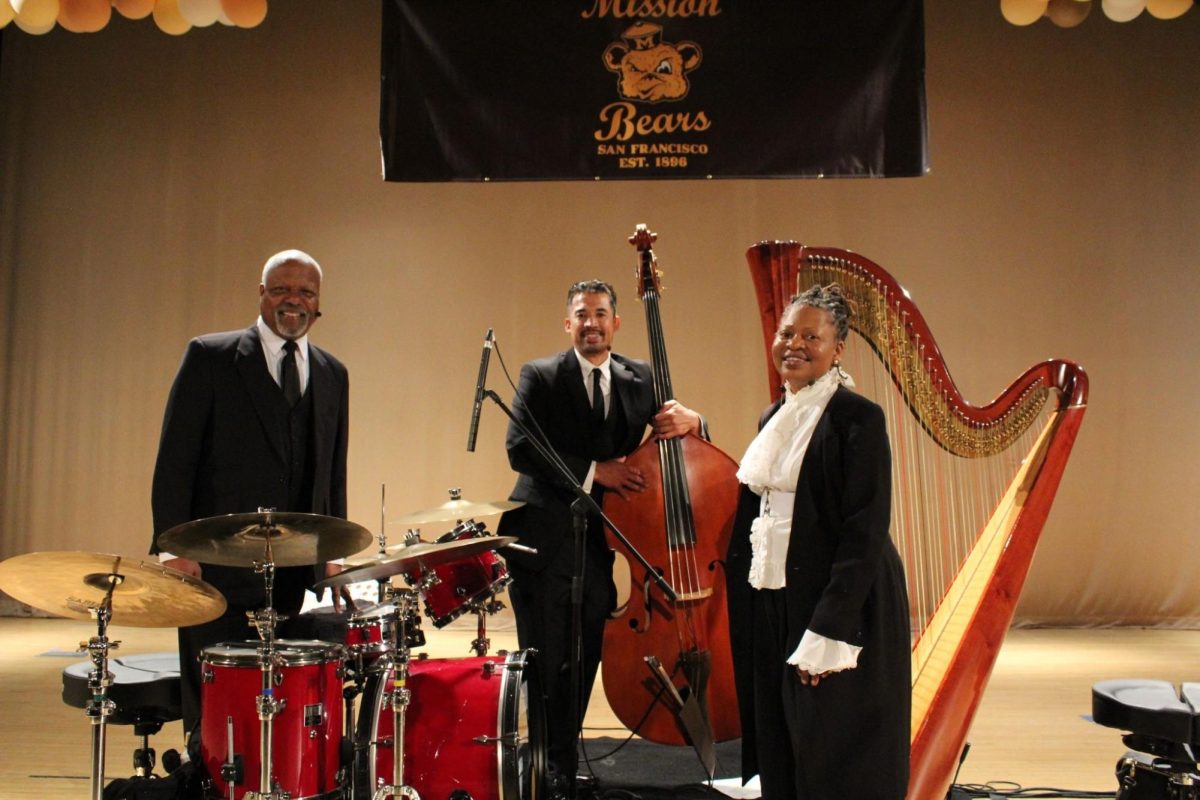
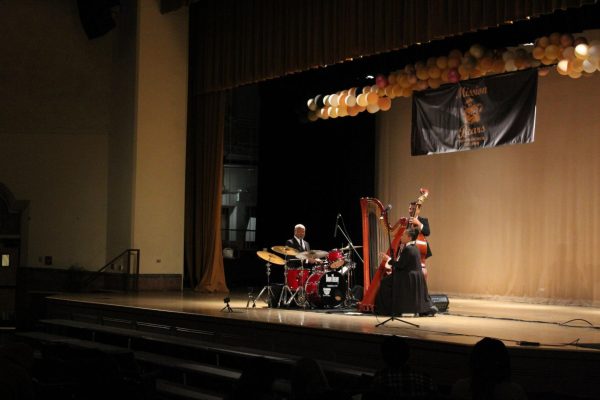
On April 8, 2026, Mission was fortunate to have Ms. Destiny Muhammad and her band, the Destiny Jazz Trio, perform for many fourth-period classes. Muhammad displayed her Jazz and Social Justice set list, featuring songs that paid tribute to various African American figures who helped change how we see Jazz as a genre and African American people as a culture.
The Destiny Jazz Trio includes three members, including Ms. Destiny as the harpist, and her supporting cast members Leon Joyce Jr, on drums and percussion, and Arthur Chico Lopez on upright bass. This trio describes itself as having a Celtic Coltrane feel, featuring cool, electric sounds with notes of Jazz and storytelling to round out the musical experience.
Taking the lens of Ms. Destiny’s musical group, many of Mission’s clubs and groups collectively participated in bringing forth the Destiny Jazz Trio to Mission High School. Beginning with club XI (pronounced as Z-Eye), a club run by Mr. Tadd Scott, which focuses on teaching and informing Mission students who are interested in learning about African American history and accomplishments. Scott and XI had a large hand in facilitating many of the logistical aspects of bringing the Destiny Jazz Trio to life at Mission, as well as at other clubs and organizations, including Mission High’s BSU, Elks Lodge, and several members of the Mission High administration.
Ms. Destiny and her Jazz group’s performance was one of the first times Mission High was able to experience a live jazz performance. Prominent S.F. Jazz artists, namely, Ms. Destiny, don’t come around often; as a result, it is worth noting who she is outside of just her harpist playing abilities.
Ms. Destiny was born and raised in Compton, California. Her first exposure to the harp instrument was at nine years of age, from Harpo Marx, on an episode of I Love Lucy back in the 70s. Not to mention, this one instance of exposure for Ms. Destiny was never actualized until the age of thirty, taking her 21 years to find her way back to the instrument.
All things considered, getting started on the Harp wasn’t easy for Ms. Destiny. She mentioned during her concert, “In all of my classes, I was the oldest student.” Considering her starting age of 30, Ms. Destiny continued to cover how it was a struggle to even get lessons, due to many Harpist teachers’ concerns towards older students and their commitment towards learning. Nevertheless, Muhammad has shown us that this practice and commitment to the harp have paid off; likewise, for a true musician, she gathered her abilities and her learnings, even her own harp instrument, from different areas and connections throughout California, truly exemplifying what it means to be a California native through every note.
During Ms. Destiny’s jazz and social justice performance at MHS, she highlighted numerous individuals within the African American community who have sparked change and advanced social justice, performing songs in their honor. Yet, the impact of her performance reached beyond celebrating these trailblazers; it resonated deeply with students in the audience. To gain a deeper understanding of this influence, I spoke with one of the students who attended the event, Hiero Kasmai.
“I thought the performance was beautiful. I really loved the harp and the drums. That was pretty cool.” Hiero continued on in retrospect about Destiny’s performance, further stating, “Some of the songs they played really changed my mind about what instruments could be used in jazz, and also how the harp can be used in a variety of different ways.”
I continued to touch on Hiero’s own personal experience with Jazz, he mentioned, “I listen to John Coltrane a lot. He has a great album, Giant Steps.” Hiero rates himself on a jazz listener scale as a seven out of 10, identifying himself as someone who has recently gotten into it.
Ms. Destiny’s performance at Mission is something that doesn’t happen very frequently. Jazz musicians just like her are innovating more into the genre of music, keeping what we call one of the most timeless genres of music, forever progressing and evolving.
Accrediting students like Hiero, who mention how the performance impacted them personally. To the recent MHS club activity, getting Ms. Destiny to come display her talents at our school displays something bigger, bigger than just an expansion of student interests. It displays that the genre of jazz is making a comeback in the younger generation as a whole.